Bigender
(also: dual-gender)

Table of Contents

- Introduction
- General Information
- History
- Flags
- External Links
- Flag Resources
- Forums
- Historical Resources
- Terminology Resources
- Miscellaneous Wiki Resources
- Public Figures
- Additional Resources
- Return to the Definition

Introduction
There are numerous nonbinary gender identities that people can identify as. Bigender is a common term that people many identify as. The term has existed since the early 20th century. Not everyone who identifies as bigender will use the same pronouns as each other, or display the same gender presentation.
There is no particular assigned sex that a person must be to identify as bigender. While this page will discuss general trends amongst those who identify as bigender, there is a wide range in how these enben will present. Ask questions of individuals before making assumptions.
Clicking on links underneath the [External Links] section will lead you to other parts of the internet that are not associated or affiliated with The Transgender Dictionary, but contain information relevant to the topic of the nonbinary gender identity known as bigender. Clicking on underlined words/terms/phrases/etc throughout the main body of this page will lead you to other parts of The Transgender Dictionary that are relevant to whatever it was that you clicked on. For pages regarding other nonbinary identities, please see the dropdown buttons in the alphabet button menu at the top of this page.
Click to jump to miscellaneous wiki resources.
Click to return to table of contents.
General Information
The term bigender can be used to describe a person who can comfortably express either alternative gender role in a variety of "socially acceptable" environments. Identifying as two genders, either alternating/varying between the two or simultaneously. These two genders may be experienced with different intensitites. Traditionally, this refers to someone who identifies as both male and female. However, this may refer to anyone who identifies as any two genders.
In day to day conversation, some bigender people may state that they identify as only one gender to avoid confusion and having to explain the details of this identity (as not everyone understands that there are people who identify as two genders at the same time). This stated identity may be the one which is felt more intensely or the one that feels more "socially acceptable" to admit to.

Bigender people typically experience gender dysphoria regarding being seen as as a man or a woman. There are various ways in which bigender people may express themselves (these ways can differ dramatically due to the diverse nature of this gender identity). Enben who identify as both male and female may prefer the mixed pronoun set of he/she (preferring to be referred to using both he/him and she/her pronouns). Others whose identities consist of other gender identities may choose other sets of pronouns, or simply they/them. Always ask someone what pronouns ze would like to have used on zem before choosing a set.
While there is no dress code to being bigender, it is not uncommon for bigender people to select clothing and/or accessories in both masculine and feminine styles. These articles may be combined in unconventional ways to convey the appearance of one who does not exclusively fit into masculinity or femininity.
Some bigender people may seek out hormone therapy (T or E) and/or surgeries to alter physical characteristics. Like some of those with other nonbinary identities that involve mixing traits - some bgender people may seek out salmacian type surgeries in an effort to pursue gender euphoria.
Bigender is under the multigender umbrella. There is overlap between the experiences of those who are bigender, and those with other gender identities which encompass more than one gender identity.
The word "bigender" is derived from the prefix "bi-" meaning "two" and the word gender. Together, the word means "two genders" or "double gender".
Click to jump to additional resources.
Click to return to table of contents.
History
In the early 20th century, "bigender" was a biological term used to refer to plants with both male and female reproductive organs (now replaced by monoecious). In the 1970s, the meaning of the word "bigender" shifted to meaning something that was intended for both men and women (similar to the word that took its place in terms of usage "coed").
The earliest known usage of this gender identity is in a pamphlet from "Human Outreach and Achievement Institute" in 1984. In this pamphlet, the word "bigenderist" was used under the category of androgyne. From the 1990s onward, the modern-day meaning of bigender emerged and has steadily gained popularity. In 2014, bigender was made avaliable as a selectable gender on Facebook.
Click to return to table of contents.
Bigender Pride Flags
There are two different bigender flags. Which one various individual bigender people will decide to use depends on personal preference. Some feel that the newer, five-striped version with the yellow stripe is more inclusive.
Regardless of which flag is preferred, displaying a bigender pride flag is a great way to let others know that you are bigender or that you are an ally of bigender people. Consider showing your bigender pride on June 17th!
Click to jump to external resources regarding the bigender flags.

Seven Striped Bigender Pride Flag
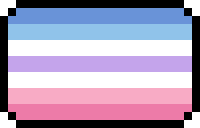
The top blue stripe of the bigender flag represents the spectrum of manhood.
The light blue stripe of the bigender flag represents the spectrum of masculinity.
The upper white stripe of the bigender flag represents positive relationships. It represents shifting from one gender to the other.
The center purple stripe of the bigender flag represents androgyny.
The lower white stripe of the bigender flag represents self respect, pride and being true to yourself. The white stripe is also representative neutral genders (such as agender) and of intersex people who identify as being bigender.
The light pink stripe of the bigender flag represents the spectrum of femininity.
The bottom pink stripe of the bigender flag represents the spectrum of womanhood.
Click to jump to external resources regarding this flag.
Click to return to table of contents.
Five Striped Bigender Pride Flag
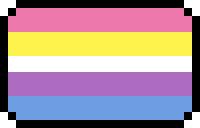
The top pink stripe in of the bigender flag represents femininity, womanhood, and female gender expression.
The yellow stripe in the bigender flag represents intersex people.
The middle white stripe in the bigender flag represents embracing more than one gender.
The purple stripe in the bigender flag represents fluidity between genders.
The bottom blue stripe in the bigender flag masculinity, manhood, and male gender expression.
Click to return to table of contents.
External Links
The following resources are not sponsored nor endorsed. These links are not affliliated with The Transgender Dictionary. These links have been provided for educational and research purposes.
Flag Resources
- Gayety: 08/02/2022: Everything You Need To Know About The Bigender Pride Flag (https://gayety.co/the-bigender-flag-meaning-origins-and-more) - article about bigender meaning, flag history, and comparison to other identities
- LGBTQIA - Wiki - Bigender (https://lgbtqia.wiki/wiki/Bigender) - this wiki goes more into modern history of flags
- Sexual Diversity: 11/22/2022: Bigender Pride Flag (https://www.sexualdiversity.org/edu/flags/1098.php) - short article regarding two most popular bigender flags, colors, and meanings
- Symbol Sage: Dani Rhys: 01/21/2024: The Bigender Flag: Exploring its History and Representation (https://symbolsage.com/bi-gender-flag-explained/) - bigender flags, controversy, meaning
- Symbols and Meanings - Bigender Flag Meaning, Origin And Colors (https://symbolsandmeanings.net/bigender-flag-meaning-origin-colors/) - article bigender flag meanings and colors (has video explanation)
- Tumblr: camp-mlm: 08/08/2019: Alternative Bigender Flag Design! (https://www.tumblr.com/the-transgenda-agenda/784362727995015168/camp-mlm-alternative-bigender-flag-design-okay) - introduction of most commonly used bigender flag
Click to return to table of contents.

Seven Striped Flag
- Flag Color Codes: Bigender (https://www.flagcolorcodes.com/bigender) - html color codes for bigender flag
- Pride Flag Guide - Bigender (https://flag.library.lgbt/flags/bigender/) - bigender flag colors and meaning
- Proud Zebra: 01/06/2021: Understanding Bigender: Its Pride Flag and Meaning (https://proudzebra.com/blogs/gender-identities/about-bigender) - bigender meaning and flag meaning
- Queer In The World: Cecilia Miller: 10/14/2023: What Exactly Is The Bigender Pride Flag, And What Does It Mean? (https://queerintheworld.com/bigender-pride-flag/) - article regarding flag colors and meaning
Click to return to table of contents.
Forum
- bigender.net (https://www.bigender.net/forum/) - online forum for people who are bigender
- Reddit - r/bigender (https://www.reddit.com/r/bigender/) - subreddit for bigender
Click to return to table of contents.
Historical Resources
- Digital Transgender Archive: THE HUMAN OUTREACH AND ACHIEVEMENT INSTITUTE (https://www.digitaltransgenderarchive.net/downloads/8g84mm373) - archived image of brochure from 1984
Click to return to table of contents.
Terminology Resources
- Dictionary - Bigender (https://www.dictionary.com/browse/bigender) - definition for bigender
- Trans Language Primer - Bigender / Trigender / etc. (https://translanguageprimer.com/bigender/) - blurb regarding bigender meaning
Click to return to table of contents.
Miscellaneous Wiki Resources
- Gender - Fandom - Gender Wiki - Bigender (https://gender.fandom.com/wiki/Bigender) - crowdmade wiki of bigender meaning and flags
- LGBTQIA - Fandom - Wiki - Bigender (https://lgbtqia.fandom.com/wiki/Bigender) - crowdmade wiki regarding bigender meaning, flag, history, similar terms
- New - LGBTQIA - Wiki - Bigender (https://new.lgbtqia.wiki/wiki/Bigender) - wiki regarding bigender meaning, flags, similar terms, history
- Nonbinary Wiki - Bigender (https://nonbinary.wiki/wiki/Bigender) - history, meaning, notable bigender people, bigender fictional characters
Click to return to table of contents.
Public Figures
- Nonbinary Wiki - A. M. Dellamonica (https://nonbinary.wiki/wiki/A.M._Dellamonica) - a science fiction writier who identifies as bigender
- R. B. Lemberg (https://www.rblemberg.net/) - personal website of Ukranian bigender sci-fi author
- Wikipedia - B - Complex (https://en.wikipedia.org/wiki/B-Complex) - wiki regarding musician who identifies as bigender
- Wikipedia - R. B. Lemberg (https://en.wikipedia.org/wiki/R._B._Lemberg) - wiki regarding bigender sci-fi writer
Click to return to table of contents.
Additional Resources
- bigenders - carrd (https://bigenders.carrd.co/) - website regarding bigender meaning, history, and flags
- Into More: Eloisa De Farias: What Does It Mean to be Bigender? (https://www.intomore.com/culture/identity/what-does-it-mean-to-be-bigender/) - article regarding bigender meaning, flag, flag meaning, allyship, history
- PubMed: Alternating gender incongruity: a new neuropsychiatric syndrome providing insight into the dynamic plasticity of brain-sex (https://pubmed.ncbi.nlm.nih.gov/22364652/) - Case, Laura K, and Vilayanur S Ramachandran. “Alternating gender incongruity: a new neuropsychiatric syndrome providing insight into the dynamic plasticity of brain-sex.” Medical hypotheses vol. 78,5 (2012): 626-31. doi:10.1016/j.mehy.2012.01.041
- Them: Erika Owen: 09/27/2023: What Does It Mean to Be Bigender? (https://www.them.us/story/what-does-it-mean-to-be-bigender) - article regarding bigender meaning, flags, comparison to other terms, dysphoria
- Wayback Machine: tumblr: anagnori: Anonymous asked: Could you describe being bigender to me? I know it's hard to describe things like it, especially when it's different for everyone. But I think I may be bigender as well and I just don't have enough information... (https://web.archive.org/web/20190414012455/https://anagnori.tumblr.com/post/71487790895/could-you-describe-being-bigender-to-me-i-know)
- Wayback Machine: tumblr: anagnori: Weird Bigender Shit (https://web.archive.org/web/20181216181523/https://anagnori.tumblr.com/post/78715029134/weird-bigender-shit)
- Wikipedia - Bigender (https://simple.wikipedia.org/wiki/Bigender) - wiki regarding bigender
Click to return to table of contents.